
Understanding Elbert County Releases
A release means that one agency has ended its custody. It does not always mean the person went home. Someone may leave the Elbert County Detention Center on bond, after time served, under a court order, or because another agency accepted custody. A transfer to the Georgia Department of Corrections, another county, federal authorities, or immigration custody is a release from the local jail but not a release to the community. The releasing authority and destination therefore matter as much as the date.
The sheriff-linked Elbert County inmate lookup centers on current custody and bookings. Once a person leaves current custody, the statutory jail docket, court order, Georgia corrections record, or receiving-agency locator becomes more useful. The Elbert County Sheriff's Office keeps the local jail record. GDC covers state prison custody. The State Board of Pardons and Paroles decides parole, while the Department of Community Supervision handles much of the supervision that follows release.
Elbert County Release Paths
A status label alone can hide a major difference. Bond and time-served releases usually end physical custody unless a hold remains. A transfer merely changes custodians. Parole is conditional release from a state prison sentence, while probation is a court-ordered form of supervision that may begin without a prison term. A dismissal may end one case, yet another warrant can still prevent a community release.
| Release path | What it means | Best next record |
|---|---|---|
| Bond | The court or authorized official permits release while the case continues. | Jail docket and court bond order |
| Time served | The custodial term or credited time is complete. | Release record and sentencing court |
| Parole or probation | The person enters supervised community status. | GDC, parole, DCS, and court records |
| Agency transfer | Local custody ends but another agency receives the person. | Receiving agency locator |
| Case dismissal | A charge ends, subject to other cases or holds. | Court disposition and jail docket |
- Discharge
- The formal end of custody or a sentence obligation shown by the responsible agency.
- Time served
- Credit for time already spent in custody.
- Detainer
- A request or hold that can send a person to another agency instead of home.
- Parole
- Conditional release from a prison sentence.
- Probation
- Court-ordered supervision in the community.
Elbert County Release Record Fields
Georgia's jail-docket law, O.C.G.A. § 42-4-7, requires a register of people committed to jail. It includes identifying and custody facts as well as the date and authority of discharge or removal. The online roster may expose only part of that record. A narrow request for the booking-and-release entry can reach the official fields that are not visible on the public grid.
| Field | What it establishes |
|---|---|
| Name and booking number | The booking tied to the person. |
| Entry date and time | When jail custody began. |
| Charge and issuing authority | Why the person entered custody and who authorized it. |
| Release date and time | When local custody ended, if maintained in that form. |
| Release reason or authority | Bond, court order, sentence completion, or another basis. |
| Transfer destination | The agency that received the person rather than a community release. |
| Bond or court reference | The order or amount connected with release. |
The public roster also has fields for name, status, sex, height, weight, address, arrest time, days in jail, total bond, warrants, charges, statutes, counts, and court. “Days in Jail” is an individual roster field, not an annual release statistic. It should not be added across records to estimate jail turnover.
Elbert County Days-in-Jail Release Context
Elbert County's public roster gives each visible record a “Days In Jail” field. That is a useful local custody fact because it shows how long that individual record has remained in the jail system at the time of the lookup. It can help distinguish a same-day bond situation from a longer stay, but it is not a countywide release count.
No official annual release total was found in the research. The individual field must not be summed from a changing roster or used to claim an average stay. Current inmates, very recent bookings, and previous-inmate search results are different groups, and the public interface does not establish that they form a complete statistical set.
Use days in jail only as a lead for the named booking. The sentence order and jail record control credited time, while the date and authority of discharge establish when local custody ended. If a person transferred, the Elbert County count stops describing only local custody and says nothing about time spent with the receiving agency.
Request Elbert County Release Records
The official route begins with the Elbert County Sheriff's Office contact and open-records path. Ask for the jail docket or booking-and-release record, not a broad search of every file. Specific identifiers reduce search time and the risk of matching the wrong person.
- Give the full name, approximate booking date, and date of birth if known.
- Add the arresting agency, charge, or case number when available.
- Request the booking number, entry and release times, release authority, bond or order, and transfer destination.
- Ask the custodian to identify any copy, certification, search, retrieval, or redaction charge before fulfillment.
- Use the proper court clerk for a bond order, sentence, dismissal, probation order, or disposition.
47 Forest Avenue
Elberton, GA 30635
706-283-2421
Use the official contact page for current routing and hours.
O.C.G.A. § 50-18-71 governs inspection, copying, and lawful fees. No fixed fee or same-day response is promised in the published research. Redactions or withholding may apply to juvenile, restricted, sealed, medical, security-sensitive, and other exempt material. If the needed record belongs to state prison custody, request it from GDC instead of the sheriff.
Georgia Rules for Elbert Releases
The jail docket statute supplies the local release framework. Georgia's Open Records Act supplies the request process, while O.C.G.A. § 50-18-72 identifies exemptions. Record restriction can also reduce what a public search returns. The GBI record-restriction information explains that qualifying criminal history information may be restricted from public access.
An empty public search is not proof that no booking occurred. Spelling, retention settings, restricted records, juvenile status, and system coverage can all affect results.
Two Elbert County Release Locations
Elbert County sources identify the detention center at 26 West Church Street and the Sheriff's Office administrative contact at 47 Forest Avenue. The two addresses serve different practical roles. Physical custody occurs at the detention center, while the sheriff's contact page provides the administrative and open-records route.
A family member asking whether physical release has occurred may need current jail information. A person seeking the statutory discharge entry should follow the records contact. Sending every question to the jail lobby can delay the record request, while sending a time-sensitive custody question only as a records request may not answer what is happening now.
Use the official sheriff contact page to confirm current routing and hours before visiting. The research does not establish a public exit door, fixed pickup point, or standard release-processing time. It would be unsafe to infer those logistics from either street address.
Elbert County Bond Release Proof
The county roster displays “Total Bond,” but that amount does not prove that bond was posted or that release occurred. It shows that bond information is tied to the booking. Check whether the person remains on the Current Inmates tab, then use the court bond order and sheriff's discharge authority to verify the event. A different hold can keep the person in custody even after bond is resolved in one case.
Courts Explain Elbert Releases
Roster charge fields do not show the full case result. The Elbert County courts directory identifies local courts, while Georgia E-Access is a statewide entry point. Court files can explain bond, dismissal, sentence completion, probation, or a transfer after the jail page shows only booking facts.
Find Released Elbert County Inmates
Start by identifying the last known custodian. A city arrest that continued into detention normally routes through the county jail. A felony sentence may move into GDC custody. Federal or immigration holds require separate systems.
- Search the sheriff-linked county locator by exact name and spelling variants.
- Compare Current Inmates with the 24-hour booking tab and booking-date search. Enable previous inmates when needed.
- Use Georgia VINELink for participating custody status and notifications.
- Search GDC when a state sentence or prison transfer is possible.
- Check the court disposition for bond, dismissal, sentence, or probation action.
- Use BOP or ICE when the record points to federal or immigration custody.
- Request the sheriff's jail docket when the public tools do not establish the release.
A released person normally leaves the current jail roster. The absence must be paired with a release record or another official custody source.
The county has a 24-Hour Releases page for interpreting its booking view. It must not be read as a list of everyone released today.
GDC Search for Elbert Releases
The Georgia Department of Corrections Find an Offender route covers state prison records, not a short county-jail bond release. Search fields include name and GDC identifying information. A matching profile can show status, location or facility history, sentence facts, maximum release date, and tentative parole month when those fields apply.
| Search fact | Use |
|---|---|
| First and last name | Begin a broad person search. |
| GDC ID | Distinguish people with similar names. |
| Status | Separate current custody from a released or inactive record. |
| Maximum release date | Read the state sentence's outside date, not a guarantee. |
| Tentative parole month | Identify a parole milestone that can change. |
The official GDC public query form is shown below. Its state scope is why it should follow, not replace, the Elbert County jail search.
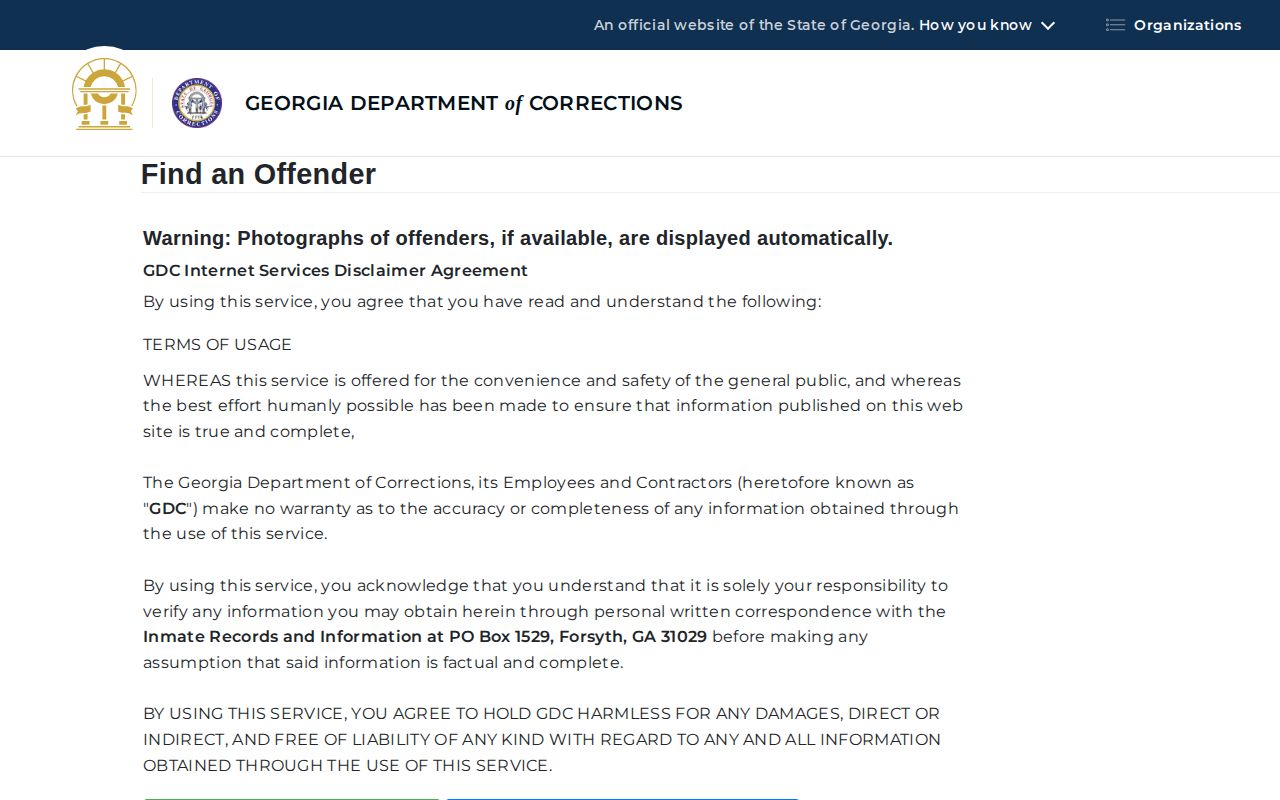
The form can establish a state-custody record after a person leaves the county jail, but the sheriff's record remains the source for the local booking and transfer.
Elbert County Roster Search Quirks
Offender Index offers Current Inmates, Bookings Made in the Last 24 Hours, and Inmates Sorted by Booking Date. The 24-hour tab is a booking feed. It is not a release list. The booking-date tab includes “Include Previous Inmates In Search,” which may help locate a person who has dropped from current custody. No distinct 72-hour release feed or stated retention period was found.
One useful comparison is a recent booking that no longer appears among current inmates. That suggests release, transfer, or removal from the visible roster, but it does not identify which occurred. Confirm through VINELink, the court, or a sheriff record. No official sheriff mobile app with a recent-release feed was identified.
VINE Alerts Fill Elbert County's Release Gap
The county roster has a current-inmate view and a 24-hour booking view, but no researched 24-hour or 72-hour release tab. Georgia VINELink is therefore especially useful when a specific person is still confined and notice of the next reported custody change is needed.
Register against the correct active result before the expected event. Choose an available phone, text, email, or app channel, complete any PIN or confirmation step, and keep the registration details. A notice may report release or transfer, so read the event label and facility rather than assuming that every alert means the person went home.
VINE closes an alert gap, not a records gap. Its feed can lag, and a released or inactive person may later disappear from current results. Pair the notice with the Elbert County jail docket for the exact discharge authority, or with GDC when the custody event belongs to a state sentence.
Elbert Post-Release Supervision
Parole is set by the State Board of Pardons and Paroles for an eligible state sentence. Probation comes from the sentencing court. After release, the Georgia Department of Community Supervision provides local field supervision through its Elberton office. Public verification may require the parolee database, GDC record, court order, and official contacts rather than one county roster.
The Post-Release Supervision page separates parole, probation, discharge, warrants, and the roles of the Board and DCS.
Elbert Release Alerts and Transfers
Georgia VINELink can supply custody-change notifications for participating feeds. Register before the expected release, choose an offered phone, text, email, or app channel, and complete any confirmation or PIN step. VINE is a notification service, not the statutory jail archive. A missing result does not establish that no release occurred.
For federal cases, use the BOP inmate locator. It covers federal prisoners and many people released from federal custody after 1982. A county record may show only a local hold or removal, while the BOP record supplies the federal custody or release status.
ICE Transfers After Elbert County Release
The Elbert County Sheriff's Office helpful-links page publishes Criminal Alien Track and Report Act quarterly PDFs, including researched 2026 material. Those official county documents establish that immigration verification and reporting are a local custody issue. They are not, by themselves, a complete individual release archive.
When a jail docket, court record, or sheriff source indicates an ICE detainer or immigration transfer, use the ICE Online Detainee Locator System for an adult in ICE detention. Search with the required A-number or biographical facts. The locator concerns ICE custody, not the earlier Elbert County booking.
Leaving the county jail for ICE ends one custodian's control but does not mean release to the community. Request the local discharge or removal entry to establish when Elbert County custody ended, then use ICE to check the next status. Do not merge those events into one release date.
Where Elbert Release Records Appear
Choose the source by custody type and by the fact that needs proof. A current roster answers a different question from a discharge record.
| Situation | Primary source | What it can show |
|---|---|---|
| Still in county jail | Elbert current-inmate tab | Current status and booking data |
| Released from county jail | Sheriff jail docket | Date and authority of discharge or removal |
| Released from state prison | GDC offender search | State status, sentence, and release fields |
| On parole or probation | Board, DCS, and court | Supervision basis and official contacts |
| Federal custody | BOP locator | Federal custody or release information |
| Immigration custody | ICE locator | Current ICE detention when covered |
Elbert County Custody Systems
Local booking begins with the Elbert County Detention Center; city arrests may begin through Elberton Police holding. State cases move to the GDC offender system, with DCS supervision and Parole Board records. Federal, immigration, and registry questions use the BOP locator, ICE locator, and Georgia registry.
The jail is listed at 26 West Church Street, while the Sheriff's Office administrative and records contact is at 47 Forest Avenue. Keeping both addresses clear prevents a physical-custody question from being sent to the wrong place and a records request from being treated as a jail-lobby inquiry.