
Georgia Parole Release Decisions
A parole release begins as a statewide decision, not an Elbert County jail action. The Board reviews eligible people serving Georgia prison sentences and may set a tentative parole month, grant parole, deny it, schedule reconsideration, or later change an earlier action. A person granted parole leaves prison custody under conditions and normally continues under supervision. Release from prison therefore does not always mean the sentence has ended.
The Board’s role is narrow but important. GDC holds the offender and maintains sentence and custody data. The Board decides parole for eligible cases. The Georgia Department of Community Supervision, or DCS, handles field supervision after release. Elbert County court records may explain the original sentence, but the county sheriff does not set a state prisoner’s parole date. Keeping those roles separate prevents a county booking record from being mistaken for a later state release decision.
Confirm a Georgia Parole Release
Begin with the official GDC Find an Offender page. Search by GDC ID when available or use name and identifying details. Open the matching profile and note the reported status, facility, maximum release date, and tentative parole month if shown. Then compare those fields with the Board’s parole sources.
- Confirm that the person has a Georgia state offender record.
- Read custody status and sentence fields before interpreting a parole date.
- Check a tentative parole month through the official TPM route.
- Use the Board process material to understand the recorded action.
- After release, check the parolee database for public supervision information.
- Use DCS or the court for the part of supervision each agency controls.
A missing parolee result does not prove that no release occurred. The person may have discharged, may be on probation rather than parole, may appear under different identifying data, or may not have an active public result. The Elbert County released-inmate guide explains how to reconnect this state record to the earlier local booking and court trail.
Georgia Parole Record Fields
Board and GDC fields describe different stages. A maximum release date is a sentence-calculation field. A tentative parole month is a projected Board milestone, not a guarantee. A grant reflects favorable parole action, while a denial or reconsideration means release has not been approved on the expected path. A rescission can change a decision before release.
| Record or action | What it means |
|---|---|
| Maximum release date | The outside GDC sentence date shown under the current calculation. |
| Tentative parole month | A provisional month used in the parole process for an eligible inmate. |
| Grant | Board action approving parole subject to required steps and conditions. |
| Denial or reconsideration | No present parole release, with later review possible when stated. |
| Parolee record | Public evidence of release to parole supervision when a matching record is available. |
Georgia does not apply one universal service percentage to every sentence. Eligibility depends on offense, sentence, sentence date, statutory restrictions, and Board rules. Some serious offenses face much stricter limits. A generic percentage should never replace the actual GDC profile and Board action.
Georgia Parole Board Records
The Board’s official pages provide the parole process, parolee database, consideration material, and statewide meeting information. Public meetings are not county parole hearings, and the meeting calendar should not be treated as a named-person decision list. For an individual record, combine the GDC profile, TPM source, public parolee search, and any Board record available for that case.
State Board of Pardons and Paroles
Official Board website
Parole process in Georgia
Georgia parolee database
Public meetings and notices
A focused records inquiry should identify the person and GDC number, name the action or date sought, and avoid asking the Board for a county jail release record it does not maintain. A county bond, dismissal, time-served release, or transfer is documented by the sheriff and court. A state parole action belongs with the Board and GDC.
Why a Georgia Parole Date Changes
A tentative parole month can move because it is not a fixed promise. The Board may grant, deny, defer, reconsider, rescind, or change parole action based on the governing law and the case record. GDC sentence adjustments, a new court order, disciplinary events, warrants, or detainers can also affect the path from an expected date to physical release.
The safest reading uses a timeline. First identify the sentence and current GDC status. Next read the TPM or other parole field. Then look for the Board outcome. Finally, after the person leaves prison, check parolee or DCS information for supervision. No single screen necessarily records every stage, and an older screenshot should not be used as proof of today’s custody status.
Georgia Parole Process Image
The official Georgia parole process page explains the statewide decision route behind parole release.
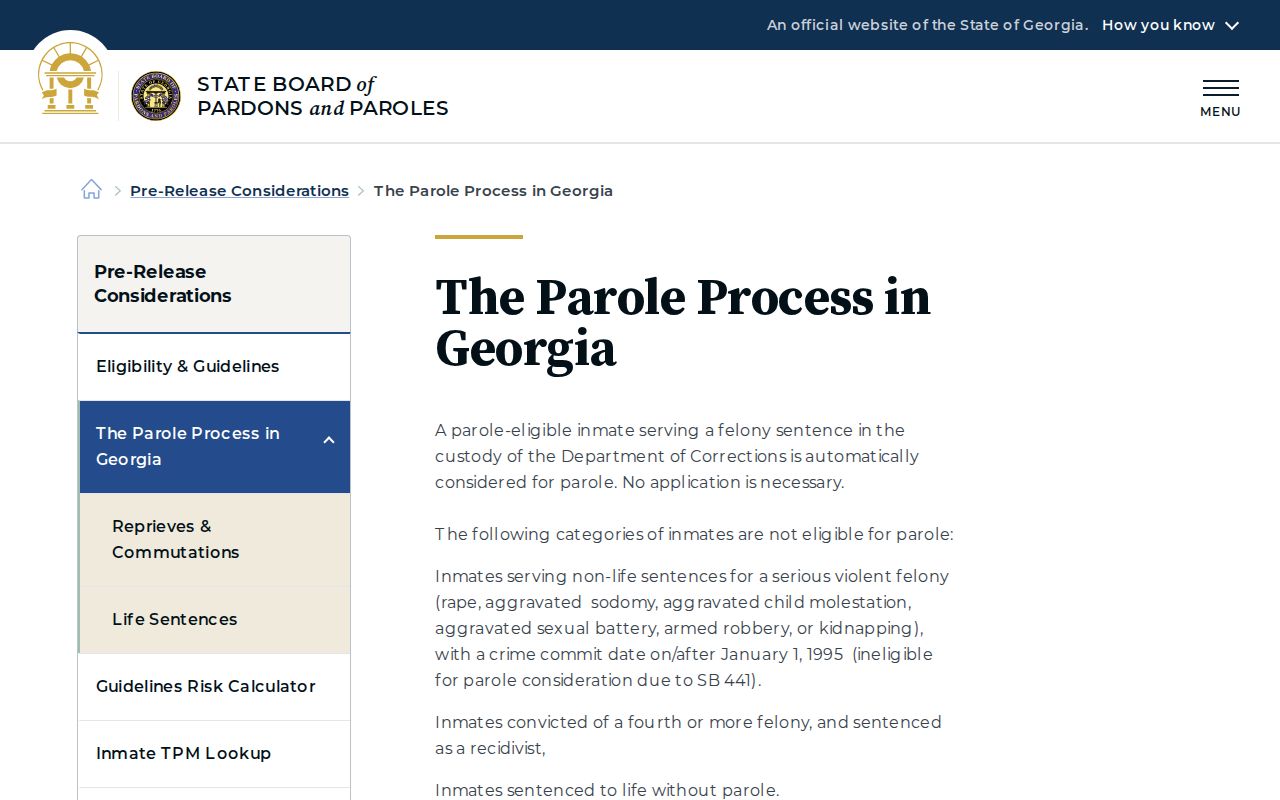
The image supports process navigation, not a named-person status conclusion. Current release verification still requires the person’s GDC and Board records.
Elbert County Parole Supervision
Once a person is released on parole to the Elbert County area, DCS becomes the field-supervision agency. DCS lists an Elberton office at 45 Forest Avenue, Elberton, GA 30635. That local listing is useful for office navigation and reporting context. It does not mean staff can disclose every detail about a person to any caller.
Probation must not be confused with parole. A court imposes probation, and a person may receive it without serving a state prison term. The Board controls parole for eligible state inmates. DCS supervises both categories after the controlling release or sentence event. Public court records can show a probation order or modification, while the parolee database is the stronger public path for parole.
Detainers After Georgia Parole Action
A favorable parole action does not always mean release directly to the community. Another county warrant, federal hold, or immigration detainer can produce a transfer. Elbert County’s sheriff posts Criminal Alien Track and Report Act material, giving this issue a real local connection. Those reports do not identify every person’s custody path and do not replace an individual record.
If the facts point to federal custody, use the BOP locator after confirming the transfer. If they point to adult ICE detention, use the ICE detainee locator. The parole record establishes the Georgia decision, while the receiving agency establishes the next custody status. A precise history may require records from both systems.